2026 SPE WORKSHOP: AI Strategic Potential for Advancing Polymeric and Hybrid Materials
Workshop
AI Strategic Potential for Advancing Polymeric and Hybrid Materials
December 8–10, 2026 All workshop days are from 11:00 AM to 1:00 PM ET. Online
Summary
The emergence of AI Agents as a new application architecture is particularly timely for addressing some of today’s complex challenges pertaining to advanced polymeric and multiphase/hybrid materials. Design, characterization, optimization, and deployment of such materials in high-performance applications, particularly within the aerospace and automotive industries, remain a major challenge. Demand for significant weight and cost reductions, higher performance, durability, safety, sustainability, and short development cycles require much deeper knowledge of these materials. At the same time, limited commercial material data, costly experimentation, prototyping, and developments are some of the major constraints driving these challenges. Enabling state-of-the-art computational tools used to predict performance across multiple scales and operating environments are stretched to their limits. This 3-day course provides a high-level overview of these challenges and solutions by identifying the most critical ones and then outlining how the utilization of enabling technologies like AI Agents would address such challenges for future material systems’ development. This workshop will address: (a) practical understanding of these real-world challenges, (b) how they impact the full utilization of polymeric and composite material systems, (c) how AI technologies can address some of these critical challenges, and (d) what AI strategies are needed for breakthroughs toward engineering and manufacturing such complex systems.
Agenda
(Click each session to expand)
December 8, 2026
Duration: 2 Hours
Outline
The big picture and the grand challenge
The notion of a material property and the persistence of ill-posed legacy definitions
Properties vs. characteristics and the controlling variables, factors, and parameters
The unique challenges and complexity posed by multiphase and hybrid materials
The growing gaps in material characterizations: experiments, simulations, vs. reality
Metadata and critical metadata as keys to utilizing polymeric and hybrid materials
Scale and size, and distinctions between material properties and system properties
Expensive experimental data such as high-speed impact and extreme environments
Material databases: what is available vs. what industries need
December 9, 2026
Duration: 2 Hours
Outline
Using AI to incorporate critical metadata into material databases
AI extraction of numerical properties and parameters used in computational methods
Extracting the immense amount of untapped data from publications
Machine-readable representations and translating chemistry into feature vectors
Multimodal numerical data, including spectroscopy, microscopy, CT/MRI images, and simulation
Materials informatics and physics-informed deep machine learning
AI utilization of molecular-dynamics data for scaling of properties
Computational prediction of properties (ICME) in addition to measurements
AI guidelines for materials with appreciable size effects (quasi-brittle)
Addressing the “small data” challenge and strategies for sparse and noisy data
December 10, 2026
Duration: 2 Hours
Outline
Using AI to fill data gaps via available and generative data
Using AI to discover relationships in complex materials data
Narrowing the design space and identifying the most valuable experiments and tests
Inverse-problem approaches to speed up the development cycle
Revisiting fundamental concepts and asking previously unasked questions
Creating digital-twin models of complex materials and predicting properties
AI management of digital-twin databases and links to materials databases
Virtual labs for material characterization, validation, and certification
If you can't attend one or several sessions live, or if you want to review some concepts, the recordings will be available after each session.
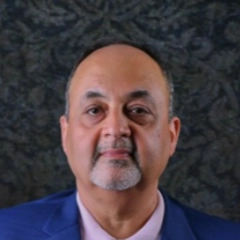
Dr Khaled Shahwan held several technical and leadership roles over a 32-year career, most recently as a Sr. Technical Advisor at Pacific Northwest National Laboratory’s Applied Materials and Manufacturing division. Prior to that, he held multiple roles at Stellantis–Fiat Chrysler Automobiles for 23 years and spent over four years at Ford Motor Company’s Research Center. Throughout his professional career, Khaled led advanced developments focused on materials modeling, design, characterization, and identification for specialized applications such as fiber-reinforced polymeric composites for high-performance, dynamic-impact, and severe-environment exposures. Dr Shahwan developed very early versions of AI models to control autonomous vehicles and deploy active-safety technologies. Khaled led multiple industry–academia–government consortia projects focused on tools to characterize, analyze, identify, design, and archive structural material systems, as well as computational tools that predict properties rather than only use them as inputs. Dr Shahwan has published over 55 publications on advanced modeling and characterization technologies for multiphase and fiber-reinforced structural composites. Khaled is an elected Associate Fellow of AIAA and serves as an External Advisory Board member for the Aerospace Engineering departments at the University of Michigan–Ann Arbor and the University of Washington–Seattle. Dr Shahwan holds a PhD and an MS in Aerospace Engineering and an MS in Civil Engineering, all from the University of Michigan–Ann Arbor, and a BS in Civil Engineering from San Francisco State University.
Engineers, scientists, materials specialists, computational-modeling and simulation professionals, AI and data-science practitioners, researchers, technical leaders, and decision-makers working with polymeric, composite, multiphase, or hybrid materials—especially in aerospace, automotive, manufacturing, and other high-performance applications.
Why Should You Attend?
Gain a practical, high-level view of the data, characterization, modeling, and development barriers that limit advanced material systems, and learn where AI Agents, materials informatics, physics-informed machine learning, digital twins, and virtual laboratories can help close critical knowledge gaps. Dr Khaled Shahwan brings 32 years of technical and leadership experience across national-laboratory and automotive research environments.
Everyday Problems You’ll Address
Limited commercial material data and expensive experimentation and prototyping
Inconsistent or ill-posed material-property definitions and missing metadata
Gaps between experimental characterization, simulation, and real operating behavior
Multiscale and size-effect challenges in multiphase and hybrid materials
Extracting usable numerical data from publications and multimodal sources
Sparse, noisy, and small datasets
Long material design, validation, and certification cycles
What You’ll Learn
Distinguish material properties, characteristics, metadata, and system properties
Explain why multiphase and hybrid materials create unique data and modeling challenges
Identify AI approaches for extracting, representing, and enriching materials data
Describe applications of materials informatics, physics-informed learning, and molecular-dynamics data
Evaluate strategies for sparse and noisy data and for narrowing experimental design spaces
Understand inverse-problem methods, digital twins, database coupling, and virtual laboratories
Frame AI strategies for faster design, characterization, validation, and deployment of advanced material systems
Why This Course Matters
Advanced polymeric and hybrid materials are central to lighter, safer, more durable, and more sustainable high-performance products, but their complexity and limited data constrain design and deployment. This course connects real industrial materials challenges with practical AI strategies that can improve knowledge capture, prediction, experimentation, digital-twin development, and future material-system engineering.
This educational program is provided as a service of SPE. The views and opinions expressed on this or any SPE educational program are those of the Speaker(s) and/or the persons appearing with the Speaker(s) and do not necessarily reflect the views and opinions of the Society of Plastics Engineers, Inc. (SPE) or its officials, employees or designees. To comment or to present an opposing or supporting opinion, please contact us at info@4SPE.org.
Refund Policy
Full refund 14 days prior to the event start date. Please contact customerrelations@4spe.org for assistance with registration.
Copyright & Permission to Use
When you enter a SPE, a division of PLASTICS event or program, you enter an area where photography, audio, and video recording may occur. By entering the event premises, you consent to interview(s), photography, audio recording, video recording and its/their release, publication, exhibition, or reproduction to be used for news, webcasts, promotional purposes, telecasts, advertising, inclusion on websites, social media, or any other purpose by SPE and their affiliates and representatives. Images, photos and/or videos may be used to promote similar events in the future, highlight the event and exhibit the capabilities of SPE. You release SPE, their officers and employees, and each and all persons involved from any liability connected with the taking, recording, digitizing, or publication and use of interviews, photographs, computer images, video and/or or sound recordings. By entering the event premises, you waive all rights you may have to any claims for payment or royalties in connection with any use, exhibition, streaming, web casting, televising, or other publication of these materials, regardless of the purpose or sponsoring of such use, exhibiting, broadcasting, web casting, or other publication irrespective of whether a fee for admission or sponsorship is charged. You also waive any right to inspect or approve any photo, video, or audio recording taken by SPE or the person or entity designated to do so by SPE. You have been fully informed of your consent, waiver of liability, and release before entering the event.
Anti-Trust Statement
No discussion among members, volunteers, or staff, which attempts to arrive at any agreement regarding prices, terms or conditions of sale, distribution, volume, territories, or customers;
No activity or communication which might be construed as an attempt to prevent any person or business entity from gaining access to any market or customer for goods or services or any business entity from obtaining services or a supply of goods;
No activity or communication which might be construed as an agreement to refrain from purchasing or using any materials, equipment, services or supplies of or from any supplier; or
No other activity which violates anti-trust or applicable laws aimed at preventing unfair competition.
This site uses cookies to recognize members so as to provide the benefits of membership. We may also use cookies to understand in general how people use and visit this site. Please indicate your acceptance to the right. Learn More..