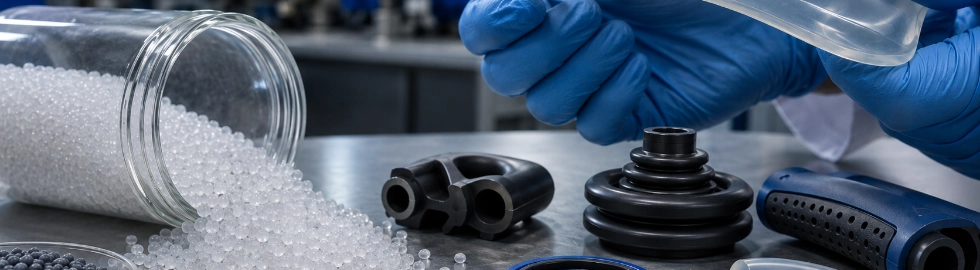
SPE WORKSHOP: Thermoplastic Elastomers (TPEs), From Fundamental Insights to Contemporary Technologies
Workshop
Thermoplastic Elastomers (TPEs), From Fundamental Insights to Contemporary Technologies
November 10, 12 & 13, 2026 All workshop days are from 11:00 AM to 1:00 PM ET. Online
Summary
With growing global concern regarding the increasing level of solid waste due to polymeric materials and interest in material recycling, thermoplastic elastomers (TPEs) provide an attractive alternative to conventional elastomers. This class of materials relies on combining thermoplastic and elastomeric properties into single macromolecules, along with physical, rather than chemical, crosslinking to introduce elasticity. While a wide range of TPEs is commercially available, most TPEs rely on a block copolymers in which macromolecules consist of three or more long, contiguous sequences of dissimilar chemical species. Due to thermodynamic incompatibility between these sequences, these molecules self-assemble into mesoscale morphologies and form a flexible molecular network that is stabilized by rigid microdomains serving as physical crosslinks. This course will introduce different types and contemporary uses of TPEs, in addition to the molecular design, synthesis and characteristics of TPEs derived from block copolymers. Thermodynamic considerations regarding network formation and bridging metrics in TPEs will be addressed by experimental observations, theoretical predictions and computer simulations. Blends of TPEs and their uses in conventional and emerging applications will be described, as will TPE chemical functionalization for specific technologies (e.g., designer additives/compatibilizers, organic photovoltaics, soft actuators, bipolar/separation membranes, and antimicrobial materials).
Topic Outline:
Different classes of TPEs as physically-crosslinked elastomers
Block copolymers differing in molecular characteristics as TPEs
Self-assembly and network formation in block copolymer TPEs
Network characteristics of TPEs varying in molecular characteristics
Structure-property relationships of TPE-containing polymer blends
Selectively-solvated TPEs as an emerging class of tunably soft materials
Viscoelasticity and network characteristics in TPE gels for targeted applications
Introduction to electroactive and other stimuli-responsive TPE systems
Functional TPEs with photoresponsive, separation and antimicrobial properties
Native/functional TPEs for toughening, compatibilization and novel purposes
Agenda
September 23, 2026
Session 1
Duration: 2 Hours
September 24, 2026
Session 2
Duration: 2 Hours
September 25, 2026
Session 3
Duration: 2 Hours
If you can't attend one or several sessions live, or if you want to review some concepts, the recordings will be available after each session.
Dr. Richard J. Spontak, Distinguished Professor at North Carolina State University, has over 40 years of experience with regard to thermoplastic elastomers (TPEs). During the past 25 years, he has explored new and exciting applications of TPEs as stimuli-responsive and functional soft materials ranging from electroactive and shape-memory media to carbon-capture membranes and antimicrobial surfaces.. He received his B.S. and Ph.D. degrees in chemical engineering from Penn State and UC Berkeley,, respectively, and he pursued post-doctoral studies at Cambridge University (UK) and the Institute for Energy Technology (Norway) before joining the Procter & Gamble Company and later North Carolina State University. He has published over 300 peer-reviewed journal publications and presented nearly 400 invited presentations worldwide, and he has received numerous awards in recognition of his research: the SPE International Award, the ACS (Rubber) Chemistry of Thermoplastic Elastomers Award, the ACS (PMSE) Roy W. Tess Award in Coatings, the Society of Polymer Science, Japan, International Award, and the Institute of Materials, Minerals and Mining (IOM3) Colwyn Medal. He is a fellow of the American Physical Society, the IOM3, the Royal Society of Chemistry, and the ACS PMSE Division, as well as a member of the Norwegian Academy of Technological Sciences.
This workshop is designed for professionals working with polymer materials and advanced material design who need a strong understanding of thermoplastic elastomers (TPEs), including:
Materials scientists and polymer engineers
R&D scientists and researchers developing new polymer systems
Product and application engineers working with flexible materials
Process and manufacturing engineers working with elastomeric systems
Technical specialists in block copolymers and functional materials
Graduate students and researchers (MSc, PhD) in polymer science
Professionals involved in developing new elastomeric materials, blends, and functional compounds
Why Should You Attend?
Thermoplastic elastomers offer a unique combination of elasticity and processability, making them an attractive alternative to conventional elastomers—especially in a context of increasing sustainability and recyclability demands.
This workshop provides a deep understanding of how molecular design, self-assembly, and physical crosslinking govern TPE performance, enabling participants to understand and design new materials, blends, and functional systems for advanced applications.
Everyday Problems You’ll Address
How do different classes of TPEs differ in structure, performance, and application?
How do block copolymer architecture and molecular characteristics affect properties?
How does self-assembly influence mechanical and viscoelastic behavior?
How can I tailor TPEs for specific applications through blending or functionalization?
How do thermodynamics and network formation affect elasticity and durability?
How can TPEs be used in emerging applications such as responsive materials or membranes?
What You’ll Learn
You will gain a comprehensive understanding of thermoplastic elastomers, including:
Fundamental principles of TPE chemistry and physical crosslinking
Structure and design of block copolymers used in TPE systems
Mechanisms of self-assembly and network formation
Relationships between structure, morphology, and properties
Behavior of TPE blends and their structure-property relationships
Viscoelastic behavior and performance of TPE systems and gels
Functionalization strategies for advanced applications
Applications of TPEs in emerging technologies such as soft actuators, membranes, and responsive systems
Why This Course Matters
Thermoplastic elastomers play an increasingly important role in modern materials engineering due to their recyclability, tunable properties, and ability to replace conventional elastomers.
This course matters because it equips professionals with the knowledge to design and optimize TPE systems, develop innovative materials and blends, and leverage advanced functionalities for next-generation applications in a wide range of industries.
This educational program is provided as a service of SPE. The views and opinions expressed on this or any SPE educational program are those of the Speaker(s) and/or the persons appearing with the Speaker(s) and do not necessarily reflect the views and opinions of the Society of Plastics Engineers, Inc. (SPE) or its officials, employees or designees. To comment or to present an opposing or supporting opinion, please contact us at info@4SPE.org.
Refund Policy
Full refund 14 days prior to the event start date. Please contact customerrelations@4spe.org for assistance with registration.
Copyright & Permission to Use
When you enter a SPE, a division of PLASTICS event or program, you enter an area where photography, audio, and video recording may occur. By entering the event premises, you consent to interview(s), photography, audio recording, video recording and its/their release, publication, exhibition, or reproduction to be used for news, webcasts, promotional purposes, telecasts, advertising, inclusion on websites, social media, or any other purpose by SPE and their affiliates and representatives. Images, photos and/or videos may be used to promote similar events in the future, highlight the event and exhibit the capabilities of SPE. You release SPE, their officers and employees, and each and all persons involved from any liability connected with the taking, recording, digitizing, or publication and use of interviews, photographs, computer images, video and/or or sound recordings. By entering the event premises, you waive all rights you may have to any claims for payment or royalties in connection with any use, exhibition, streaming, web casting, televising, or other publication of these materials, regardless of the purpose or sponsoring of such use, exhibiting, broadcasting, web casting, or other publication irrespective of whether a fee for admission or sponsorship is charged. You also waive any right to inspect or approve any photo, video, or audio recording taken by SPE or the person or entity designated to do so by SPE. You have been fully informed of your consent, waiver of liability, and release before entering the event.
Anti-Trust Statement
No discussion among members, volunteers, or staff, which attempts to arrive at any agreement regarding prices, terms or conditions of sale, distribution, volume, territories, or customers;
No activity or communication which might be construed as an attempt to prevent any person or business entity from gaining access to any market or customer for goods or services or any business entity from obtaining services or a supply of goods;
No activity or communication which might be construed as an agreement to refrain from purchasing or using any materials, equipment, services or supplies of or from any supplier; or
No other activity which violates anti-trust or applicable laws aimed at preventing unfair competition.
This site uses cookies to recognize members so as to provide the benefits of membership. We may also use cookies to understand in general how people use and visit this site. Please indicate your acceptance to the right. Learn More..