SPE WEBINAR: Fall Polymer Insights Series Part 2 — Process insight: Real-time Raman and Rheology Monitoring During Reactive Extrusion | SPESPE WEBINAR: Fall Polymer Insights Series | SPE, a division of PLASTICS
Sponsored by
Webinar
Fall Polymer Insights Series Part 2 — Process insight: Real-time Raman and Rheology Monitoring During Reactive Extrusion
October 8, 2026 10:00 AM ET Online
Sponsored by
Thermo Fisher Scientific — supporting polymer and vinyl innovation across the materials value chain with solutions for compounding, extrusion, rheological analysis, process development, quality control, and materials characterization.
Summary
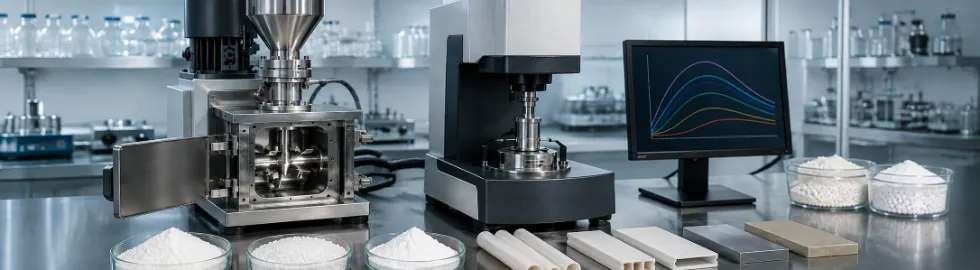
Reactive extrusion processes often rely on predetermined run times to define process endpoints, even though actual process conditions may stabilize much sooner. In this webinar, we'll demonstrate how integrating the Thermo Scientific™ MarqMetrix™ All-In-One Process Raman Analyzer with the Thermo Scientific™ HAAKE™ MiniLab™ 3 creates a powerful workflow that combines in-line Raman spectroscopy and rheological measurements to provide deeper process insight during reactive extrusion. Through this application study, attendees will see how Raman and rheology work together to track starch plasticization, correlate molecular changes with rheological behavior, and identify process stabilization earlier than a conventional 15-minute run. The result is improved process understanding, greater confidence in endpoint determination, and a faster, more data-driven approach to process optimization and development.
If you can't attend one or several sessions live, or if you want to review some concepts, the recordings will be available after each session.
Janam Pandya, PhD, is a scientist and spectroscopist with over ten years of academic and industry experience. He earned his PhD from the University of Massachusetts Amherst, where he developed novel analytical methods using advanced Raman spectroscopy. As a Product Manager at Thermo Fisher Scientific, Janam works to advance Raman spectroscopy for real-time process measurements across a wide range of industrial applications, including polymers.
Dr. Lucivan Barros is a Senior Applications Scientist at Thermo Fisher Scientific, where he supports application development for the Material Characterization portfolio, with a focus on extrusion and rheology. He earned his bachelor’s degree in metallurgical and Materials Engineering and his master’s degree in Materials Science and Engineering from the State University of Rio de Janeiro. He later received his Ph.D. in Macromolecular Science from Case Western Reserve University in 2021. Before joining Thermo Fisher Scientific, he worked as a Research Associate at Case Western Reserve University, leading projects on TPU synthesis, melt processing, and nanocomposites. His expertise includes polymer processing, structure-property relationships, rheology, and advanced polymer characterization.
Who Should Attend?
The course is suitable for process engineers, extrusion and compounding specialists, polymer and materials scientists, R&D and formulation scientists, Process Analytical Technology (PAT) professionals, and anyone seeking to combine Raman spectroscopy with rheology for improved process understanding and optimization.
Why Should You Attend?
Knowing when a reactive extrusion process has reached process stabilization can be challenging. This webinar demonstrates how integrating in-line Process Raman spectroscopy into a reactive extrusion workflow provides real-time process insight, helping improve process understanding, identify process stabilization earlier, and support more confident endpoint decisions. Through an application study, you'll see how continuous, in-line process measurements correlate with viscosity, provide deeper insight into starch plasticization, and demonstrate the potential of real-time monitoring to improve process understanding and support process optimization.
At the end of this course, you will…
Understand how torque rheometry can be used to evaluate PVC dry blends and related vinyl materials.
See how a laboratory mixer test is prepared, loaded, run, evaluated, and cleaned.
Learn how to interpret key features of a PVC mixer curve, including loading behavior, fusion, steady-state torque, relative melt viscosity, and degradation onset.
Recognize how sample weight, rotor speed, mixer temperature, and feeding method can affect reproducibility.
Understand how changes in stabilizer content can influence PVC stability and fusion behavior.
Connect lab-scale mixer results to practical decisions in extrusion, compounding, quality control, and process development.
This educational program is provided as a service of SPE. The views and opinions expressed on this or any SPE educational program are those of the Speaker(s) and/or the persons appearing with the Speaker(s) and do not necessarily reflect the views and opinions of the Society of Plastics Engineers, Inc. (SPE) or its officials, employees or designees. To comment or to present an opposing or supporting opinion, please contact us at info@4SPE.org.
Copyright & Permission to Use
When you enter a SPE, a division of PLASTICS event or program, you enter an area where photography, audio, and video recording may occur. By entering the event premises, you consent to interview(s), photography, audio recording, video recording and its/their release, publication, exhibition, or reproduction to be used for news, webcasts, promotional purposes, telecasts, advertising, inclusion on websites, social media, or any other purpose by SPE and their affiliates and representatives. Images, photos and/or videos may be used to promote similar events in the future, highlight the event and exhibit the capabilities of SPE. You release SPE, their officers and employees, and each and all persons involved from any liability connected with the taking, recording, digitizing, or publication and use of interviews, photographs, computer images, video and/or or sound recordings. By entering the event premises, you waive all rights you may have to any claims for payment or royalties in connection with any use, exhibition, streaming, web casting, televising, or other publication of these materials, regardless of the purpose or sponsoring of such use, exhibiting, broadcasting, web casting, or other publication irrespective of whether a fee for admission or sponsorship is charged. You also waive any right to inspect or approve any photo, video, or audio recording taken by SPE or the person or entity designated to do so by SPE. You have been fully informed of your consent, waiver of liability, and release before entering the event.
Anti-Trust Statement
No discussion among members, volunteers, or staff, which attempts to arrive at any agreement regarding prices, terms or conditions of sale, distribution, volume, territories, or customers;
No activity or communication which might be construed as an attempt to prevent any person or business entity from gaining access to any market or customer for goods or services or any business entity from obtaining services or a supply of goods;
No activity or communication which might be construed as an agreement to refrain from purchasing or using any materials, equipment, services or supplies of or from any supplier; or
No other activity which violates anti-trust or applicable laws aimed at preventing unfair competition.
84 countries and 85.6k+ stakeholders strong, SPE
unites
plastics professionals worldwide – helping them succeed and strengthening their skills
through
networking, events, training, and knowledge sharing.
No matter where you work in the plastics industry
value
chain-whether you're a scientist, engineer, technical personnel or a senior executive-nor
what your
background is, education, gender, culture or age-we are here to serve you.
Our members needs are our passion. We work hard so
that we
can ensure that everyone has the tools necessary to meet her or his personal & professional
goals.
This site uses cookies to recognize members so as to provide the benefits of membership. We may also use cookies to understand in general how people use and visit this site. Please indicate your acceptance to the right. Learn More..