SPE WEBINAR: Fall Polymer Insights Series | SPE, a division of PLASTICS

Sponsored by

  Workshop

Fall Polymer Insights Series Part 3 — Flow characterization: PVC Extrusion and Capillary Rheology

  December 3, 2026
  10:00 to 11:00 AM ET.
  Online

Sponsored by

Thermo Fisher Scientific — supporting polymer and vinyl innovation across the materials value chain with solutions for compounding, extrusion, rheological analysis, process development, quality control, and materials characterization.
Fall Polymer Insights Series Part 3 — Flow characterization:** PVC Extrusion and Capillary Rheology

  Summary

PVC processing behavior depends not only on formulation, but on how the material flows under the shear conditions encountered during extrusion.

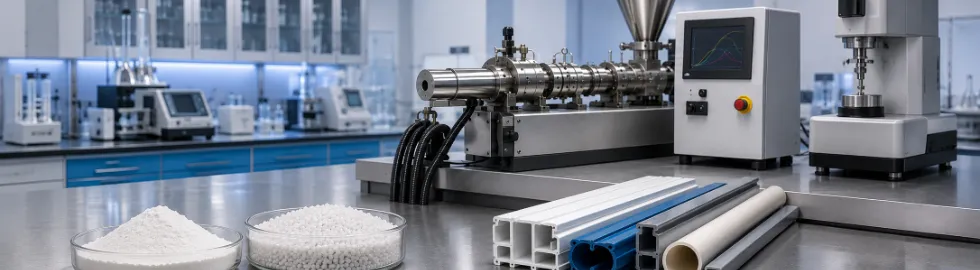
In this practical technical webinar, Matthias Jährling, Senior Application Manager at Thermo Fisher Scientific, demonstrates how laboratory extrusion and capillary rheology can be used to characterize the flow behavior of PVC. The session covers extrusion fundamentals, the role of counter-rotating extruders in PVC processing, the principles behind capillary rheology, and a hands-on viscosity measurement using a laboratory extruder and slit capillary die.

Viewers will see how measurements at different extrusion speeds are used to generate shear rate, shear stress, and viscosity data; how reproducibility and measurement validity can be evaluated; and how corrected viscosity data can be used to better understand material behavior and support rheological modeling. The webinar connects practical laboratory measurements with decisions in PVC extrusion, formulation development, process optimization, and material characterization.


If you can't attend one or several sessions live, or if you want to review some concepts, the recordings will be available after each session.

  Registration Information

All AtendeesFREE

Not an SPE member? Join today!


1 Session
 
Level: Intermediate
 
Total Hours: 1 Hour
 
Streaming access on desktop and mobile browsers

  Instructor

Matthias Jährling
Senior Application Manager
Thermo Fisher Scientific
  LinkedIn

Matthias Jährling is Senior Application Manager for Materials and Structural Analysis within Material Characterization at Thermo Fisher Scientific. He manages the Material Characterization Process/Pharma laboratories and leads the application group. Matthias holds a degree in Chemical Engineering with a focus on Polymer Chemistry from Hochschule Reutlingen. His expertise includes extrusion, rheology, polymers, compounding, and nanomaterials, with extensive experience supporting application development and process optimization across polymer industries.


  Questions? Contact:

For questions, contact Iván D. López.


  Who Should Attend?

The course is suitable for PVC and vinyl compounders, extrusion and process development engineers, polymer formulation scientists, rheologists, materials scientists, quality control teams, technical service teams, and laboratory professionals seeking to better understand PVC flow behavior and its relationship to extrusion processing.

  Why Should You Attend?

Understanding how PVC flows under processing conditions is critical to developing formulations and extrusion processes that perform consistently.

This webinar provides a practical look at how laboratory extrusion and capillary rheology can be combined to characterize PVC flow behavior under relevant shear conditions. Matthias Jährling demonstrates the measurement workflow from extrusion and sample preparation through pressure and output measurements, viscosity curve generation, reproducibility assessment, and data correction. Attendees will come away with a clearer understanding of how rheological data can help explain PVC processing behavior and support formulation development, process optimization, and modeling.

  At the end of this course, you will…

  • Understand the fundamentals of PVC extrusion and why extruder design and processing conditions matter for PVC dry blends.
  • Understand how capillary rheology can be used to characterize polymer flow behavior under extrusion-relevant shear conditions.
  • See how extrusion speed, pressure, and material output are used to calculate shear rate, shear stress, and viscosity.
  • Recognize shear-thinning behavior and understand how viscosity changes as shear rate increases.
  • Learn how measurement reproducibility and pressure behavior can be evaluated during a capillary rheology test.
  • Understand how corrected viscosity data and rheological models can support material characterization, process development, and simulation.

This educational program is provided as a service of SPE. The views and opinions expressed on this or any SPE educational program are those of the Speaker(s) and/or the persons appearing with the Speaker(s) and do not necessarily reflect the views and opinions of the Society of Plastics Engineers, Inc. (SPE) or its officials, employees or designees. To comment or to present an opposing or supporting opinion, please contact us at info@4SPE.org.

Copyright & Permission to Use

When you enter a SPE, a division of PLASTICS event or program, you enter an area where photography, audio, and video recording may occur. By entering the event premises, you consent to interview(s), photography, audio recording, video recording and its/their release, publication, exhibition, or reproduction to be used for news, webcasts, promotional purposes, telecasts, advertising, inclusion on websites, social media, or any other purpose by SPE and their affiliates and representatives. Images, photos and/or videos may be used to promote similar events in the future, highlight the event and exhibit the capabilities of SPE. You release SPE, their officers and employees, and each and all persons involved from any liability connected with the taking, recording, digitizing, or publication and use of interviews, photographs, computer images, video and/or or sound recordings. By entering the event premises, you waive all rights you may have to any claims for payment or royalties in connection with any use, exhibition, streaming, web casting, televising, or other publication of these materials, regardless of the purpose or sponsoring of such use, exhibiting, broadcasting, web casting, or other publication irrespective of whether a fee for admission or sponsorship is charged. You also waive any right to inspect or approve any photo, video, or audio recording taken by SPE or the person or entity designated to do so by SPE. You have been fully informed of your consent, waiver of liability, and release before entering the event.

Anti-Trust Statement

  1. No discussion among members, volunteers, or staff, which attempts to arrive at any agreement regarding prices, terms or conditions of sale, distribution, volume, territories, or customers;
  2. No activity or communication which might be construed as an attempt to prevent any person or business entity from gaining access to any market or customer for goods or services or any business entity from obtaining services or a supply of goods;
  3. No activity or communication which might be construed as an agreement to refrain from purchasing or using any materials, equipment, services or supplies of or from any supplier; or
  4. No other activity which violates anti-trust or applicable laws aimed at preventing unfair competition.

For more information, visit the SPE Code of Conduct page.

spe2018logov4.png
Welcome Guest!   Login